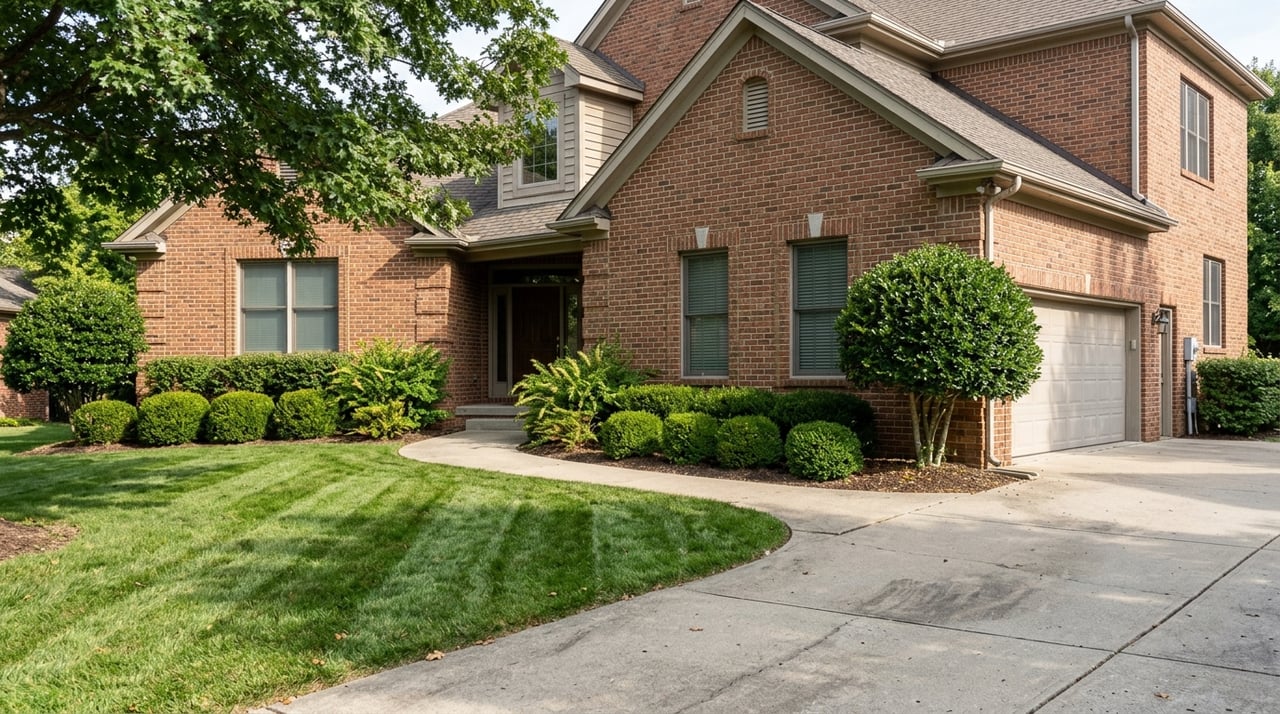
Why Two "Maryville" Homes Can Carry Very Different Tax Bills
Picture two houses a few minutes apart, both listed with a Maryville, TN address, both assessed at roughly the same value, both a reasonable drive from downtown. One owner writes a single property tax check each year. The other writes two, to two different governments, on two different calendars, and ends up paying close to double.
Nothing about the listing photos, the ZIP code, or the school zone tells you which house is which. The only way to know is to check which side of a boundary that Google Maps won't draw for you the property actually sits on.
Most buyers assume a "Maryville" address means the home is inside the City of Maryville. It often doesn't. A large share of homes with Maryville mailing addresses sit in unincorporated Blount County, outside the city's legal boundary entirely, because postal addressing follows mail routes, not municipal lines.
That gap used to close itself over time, as cities grew and annexed the land around them. It doesn't anymore. In 2014, the Tennessee General Assembly passed Public Chapter 707, ending a city's ability to annex property without the owner's agreement. Under current law, a municipality can only bring land into its limits through owner consent or a referendum vote, a change tracked in detail by the Tennessee Municipal Technical Advisory Service. Maryville can't simply draw a bigger circle around itself. It has to be invited in, parcel by parcel.
That's why the city limit today looks less like a boundary and more like a jigsaw puzzle still being assembled. A subdivision built in 2005 might sit inside city limits. The farmhouse next to it, owned by the same family since before annexation law changed, might not. Both have Maryville addresses. Only one pays a city tax bill.
Here's where the puzzle turns into real money. Blount County set its 2025 property tax rate at $1.59 per $100 of assessed value, a figure confirmed on the county's own property tax page. That rate applies to every taxable parcel in the county, city or no city.
If your parcel also sits inside Maryville's city limits, you owe a second bill on top of that, calculated by the City of Maryville at its own separate rate. City council raised that rate by 13 cents for the fiscal year that began in July 2025, pushing it from $1.50 to $1.63 per $100 of assessed value, largely to help fund the ongoing Maryville High School expansion. City officials floated another possible 11-cent increase for the following fiscal year tied to the same $55 million bond, so the gap between city and county tax bills is more likely to widen from here than narrow.
Run the math on a home near Maryville's recent median sale price of $394,500 (as of April 2026) and the difference stops being abstract:
| Unincorporated Blount County | Inside Maryville City Limits | |
|---|---|---|
| Assessed value (25% of $394,500) | $98,625 | $98,625 |
| County rate | $1.59 / $100 | $1.59 / $100 |
| City rate | — | $1.63 / $100 |
| Estimated annual tax | ~$1,568 | ~$3,176 |
| Monthly equivalent | ~$131 | ~$265 |
Same assessed value. Same market. Roughly double the annual tax bill, purely because of which side of an invisible line the parcel falls on. That's a difference no median-price chart on a listing portal will ever show you, because those medians blend every parcel in the ZIP code together without separating city from county.
If the boundary feels arbitrary, watch how it actually gets redrawn, because it rarely happens quietly or quickly.
Walmart bought 27.8 acres on East Lamar Alexander Parkway back in 2015, and the city annexed the land that March under a development agreement where Maryville agreed to cover a new traffic signal and a sanitary sewer extension in exchange for the tax base a second store would bring. Three years later, Walmart walked away entirely, telling the city its customers' needs had changed. The development agreement was declared null and void. Nathan Higdon, who had organized a group called Keep Maryville Quaint in response to the original plan, called the reversal "a win for the community."
Nine years after the first attempt, the project came back. In June 2025, Maryville's Municipal Planning Commission approved a preliminary site plan for a Walmart Supercenter on the same corridor, this time spanning more than 200,000 square feet with a 16-vehicle fuel center. By November 2025, the city council was working through the annexation details again, including infrastructure the city expects to spend roughly $1 million on, and hearing from at least one neighboring resident, Randy McCampbell, whose family driveway sits directly across from the site and would shrink to under 10 feet under the current plan.
The same council meeting also annexed a very different kind of parcel: 22 acres donated by the Foothills Land Conservancy to become Billy Minser Park, honoring the wishes of the late Catherin Gilreath. As of July 2026, the planning commission was still processing individual annexation requests on other tracts, including one from Big Springs Investment Company on Big Springs Road. Annexation in Maryville isn't a single event. It's a slow, ongoing negotiation that plays out property by property, sometimes for park land, sometimes for retail, sometimes taking the better part of a decade to resolve.
If your parcel is inside city limits, the paperwork doesn't sync up either. The City of Maryville mails its notices in late summer, with payment due between September 1 and November 30 and a 2.33 percent monthly penalty kicking in December 1. Blount County runs its own schedule, offering a 2 percent discount for payment by the end of October and a 1 percent discount through November, on a separate notice from a separate office. A homeowner inside city limits is tracking two due dates, two discount windows, and two penalty clocks every year, not one.
At closing, Tennessee law also treats the tax year as running January 1 through December 31 regardless of when a sale happens, and Blount County's own guidance confirms that taxes are typically prorated at closing with the buyer becoming the responsible party going forward. Get the city-or-county status wrong before you write an offer, and you're not just misjudging a monthly payment. You're misjudging the number your lender uses to size your escrow account.
How do I find out if a specific address is inside Maryville's city limits? The Blount County Property Assessor's office maintains parcel-level records that show municipal boundaries, and the city's own planning department can confirm status on request. This is worth checking before you tour a home you're serious about, not after you've made an offer.
If my future neighborhood gets annexed later, does my tax bill go up automatically? Only if annexation actually happens, and under current Tennessee law that requires either the property owner's written consent or a referendum vote. Nobody can annex your home into city limits without your agreement.
Are property taxes prorated when I buy partway through the year? Yes. The official tax roll is set as of January 1 each year, and Blount County's standard practice is to prorate the annual bill at closing, with the buyer taking on responsibility for the portion of the year they own the home.
The address on a listing tells you which school zone you're in and roughly how far you'll drive to Broadway Avenue. It doesn't tell you which government sends you a tax bill, or how many. That's a parcel-level question, and it's exactly the kind of detail worth confirming before you're emotionally attached to a house.
If you're comparing homes across Maryville and Blount County and want a clear read on what a specific property actually costs to own, not just what it costs to buy, Robin L Skeen can walk the parcel records with you before you write an offer. Request Your Free Home Valuation and start with the full picture.
Stay up to date on the latest real estate trends.
Buying and selling real estate can be a stressful life event. Let 30 years of experience work for you! Robin can assist you in working toward a successful transaction.